
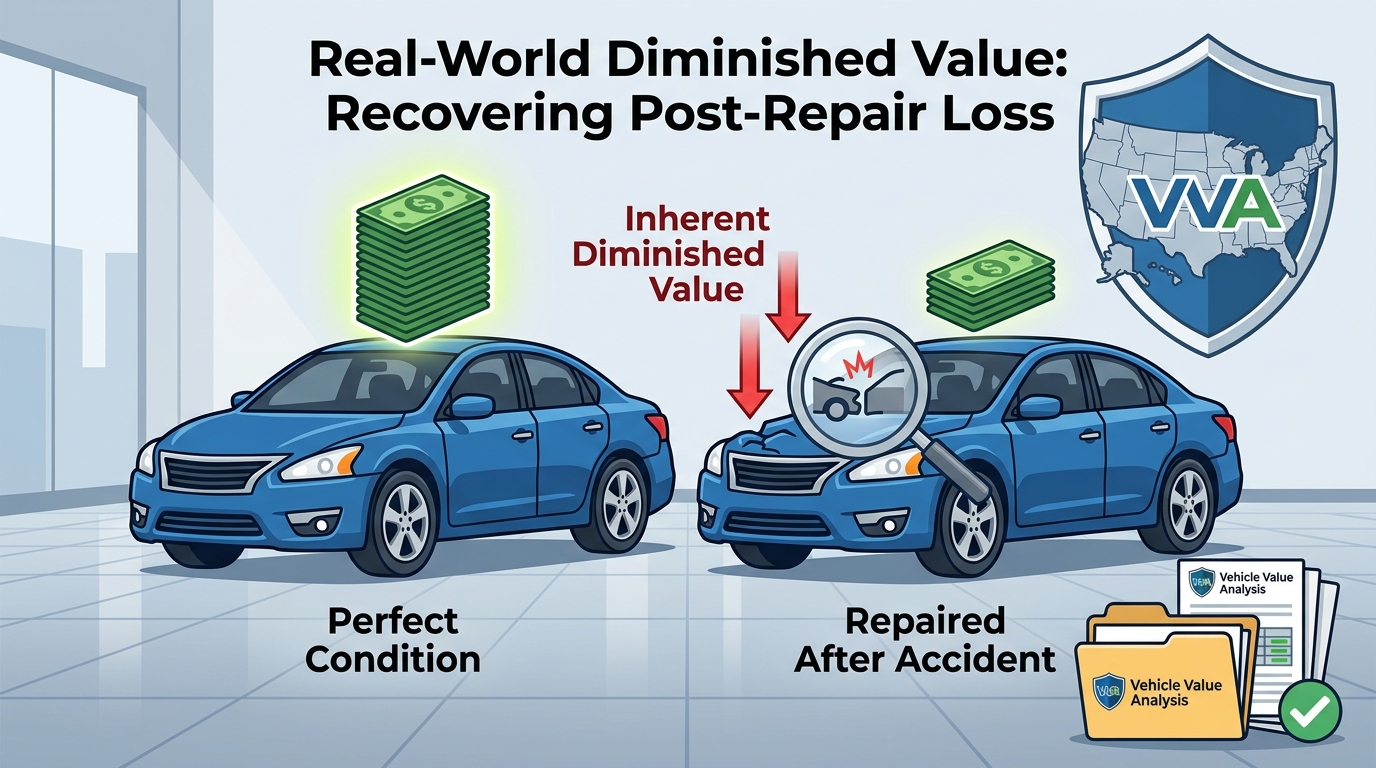
Even after your vehicle undergoes perfect repairs following an accident, its market value has likely dropped. This financial loss belongs to you, not the at-fault driver. According to industry data, diminished value coverage is available in all 50 states, yet most policyholders remain unaware of their right to recover this post-repair loss. Inherent diminished value represents the permanent reduction in a vehicle's worth simply because it now carries an accident history, regardless of how well it was fixed.
What Is Diminished Value?
Diminished value is the difference between what your car was worth before the accident and what it is worth after the repairs are completed. This concept is critical because the market perceives any vehicle with an accident history as less desirable than a clean-title equivalent. Inherent diminished value is the permanent loss in market value that remains after repairs.
Insurance companies often argue that once repairs are finished, they have fulfilled their obligation. However, real-world market data shows that buyers are willing to pay significantly less for a previously damaged vehicle. This gap is where your claim lies. By quantifying this loss, you can demand the compensation you deserve rather than accepting a settlement that ignores the true cost of the accident.
Inherent vs. Repair-Related Loss
Understanding the distinction between different types of value loss is essential for a successful claim. Most claims focus on inherent diminished value, which applies to vehicles that are less than ten years old and have fewer than 100,000 miles. This type of loss is automatic and does not require proof of poor workmanship.
The Role of Repair Quality
While inherent diminished value exists regardless of repair quality, the quality of repairs can exacerbate the loss. If the repairs were substandard, the vehicle may suffer from repair-related diminished value. This occurs when the workmanship fails to restore the vehicle to its pre-accident condition, leading to further depreciation. However, even with perfect repairs, the stigma of the accident history remains.
When Does It Apply?
Not all vehicles qualify for diminished value claims. Generally, the vehicle must be relatively new, and the accident must not be your fault. If you are at fault, your own insurance policy typically excludes this coverage, leaving you to seek compensation from the at-fault party's insurer. Recover post-repair loss by ensuring you file against the correct liability carrier.
How Valuation Works
Calculating diminished value is not a guesswork exercise. It relies on verified comparable sales and defensible mathematical formulas. The process involves analyzing the pre-loss Actual Cash Value (ACV) and comparing it to the post-repair market value.
Verified Comparable Sales
At the core of any robust valuation is the use of real comparable sales. These are listings of identical or very similar vehicles that have been sold recently. By comparing your vehicle to these comps, we can establish a baseline for what the market is actually paying for a clean vehicle versus a damaged one. Real comparable sales provide the objective data needed to challenge insurer lowballs.
The 17c Formula and Deviation
While the 17c formula is a common starting point for negotiations, it is often criticized for undervaluing the loss. A more accurate approach uses a deviation-percentage formula based on the specific make, model, age, and mileage of your vehicle. This method adjusts the base percentage to reflect the unique depreciation curve of your car, ensuring the demand letter is both aggressive and defensible.
Report Types for Policyholders
Vehicle Value Analysis offers tiered reporting options designed to meet different stages of the claims process. Each report is delivered digitally and includes the necessary documentation to support your demand.
| Report Type | Best For | Key Features |
|---|---|---|
| Silver Report | Initial Assessment | Free estimate, basic market value range, no detailed comps. |
| Gold Report | Standard Claims | Full diminished value calculation, verified comps, demand letter. |
| Platinum Report | Complex/High Value | Comprehensive analysis, expert testimony support, detailed deviation analysis. |
The Gold Report is the most popular choice for individual policyholders. It provides a complete appraisal establishing the true pre-loss value and includes a carrier demand letter pre-addressed to the at-fault insurance company. This report is backed by a money-back guarantee, ensuring you only pay if the report meets your expectations.
The Claim Process
Filing a diminished value claim can be daunting, but having the right documentation simplifies the process significantly. The goal is to present an irrefutable case to the insurance adjuster.
Step 1: Obtain Your Report
Start by generating your diminished value report. This process takes only minutes and requires basic vehicle information. The report will quantify your loss using the methodology described above. Inherent diminished value report pricing starts at $199.95, which is a small investment compared to the potential recovery.
Step 2: Submit the Demand
Once you have your report, submit the demand letter to the at-fault party's insurance carrier. Be prepared for pushback. Adjusters are trained to minimize payouts. They may argue that your car is "made whole" because it drives like new. Counter this by emphasizing the market stigma and the verified loss in resale value.
Step 3: Negotiation or Appraisal
If the initial offer is unsatisfactory, you can enter negotiations. Your report serves as the primary evidence. If negotiations stall, most insurance policies include an appraisal clause. This allows you and the insurer to hire independent appraisers to resolve the dispute. Diminished value coverage claims often resolve favorably during this stage due to the strength of the data provided.
Key Takeaways
- Post-Repair Loss is Real: Your vehicle loses value immediately after an accident, even with perfect repairs.
- Eligibility Criteria: Generally applies to vehicles under 10 years old with under 100,000 miles.
- Verified Data is Key: Claims supported by real comparable sales are far more likely to succeed.
- Report Options: Choose between Silver, Gold, or Platinum reports based on your claim's complexity.
- Guarantee Protection: Vehicle Value Analysis offers a $600 money-back guarantee on their reports.
- Fast Delivery: Reports are delivered in minutes, not days, accelerating your claim timeline.
- Legal Support: Reports are recognized by major insurance carriers and can support legal action if needed.
Frequently Asked Questions
How long do I have to file a diminished value claim?
Statutes of limitations vary by state, but generally, you have two years from the date of the accident to file a claim. It is crucial to act quickly to preserve evidence and ensure your vehicle's condition is accurately assessed.
Does my insurance company have to pay for diminished value?
If you are the at-fault driver, your own insurance policy typically does not cover diminished value. However, if another driver is at fault, their liability insurance is responsible for compensating you for the loss in your vehicle's value.
What is the difference between a Silver and Gold report?
A Silver report provides a free, preliminary estimate of your vehicle's value and potential loss. A Gold report includes a full diminished value calculation, verified comparable sales, and a formal demand letter ready for submission to the insurance carrier.
Can I get a refund if I don't like the report?
Yes. Vehicle Value Analysis offers a $600 money-back guarantee. If you are not satisfied with the report's accuracy or utility, you can request a refund under their policy terms.
How is the diminished value percentage calculated?
The percentage is calculated using a deviation-percentage formula that considers the vehicle's age, mileage, make, model, and the severity of the damage. This data is cross-referenced with real comparable sales to ensure accuracy.
Do I need a lawyer to file a diminished value claim?
While not strictly necessary, having a professional report strengthens your position significantly. In complex cases or high-value vehicles, consulting with a personal injury attorney may be beneficial to ensure maximum recovery.
What is the 17c formula?
The 17c formula is a method used by some insurance companies to calculate diminished value. It starts with a base percentage of the pre-loss value and applies deductions based on age and mileage. However, many experts argue this formula undervalues the loss, making independent reports essential.
Recover Your Vehicle's True Value Today
Do not let insurance companies undervalue your loss. You have the right to recover the post-repair diminished value of your vehicle. Start by getting your free Silver Report or order a comprehensive Gold Report to support your claim. See your car's real market value instantly and take the first step toward fair compensation.