
Even after your vehicle undergoes perfect repairs, its market value has likely dropped permanently. This financial loss belongs to you, not the at-fault driver. According to industry data, diminished value claims are frequently ignored by insurance carriers, leaving vehicle owners with significant under-indemnification. This guide explains how to quantify that loss using verified comparable sales and recover the money you are owed.
What Is Diminished Value?
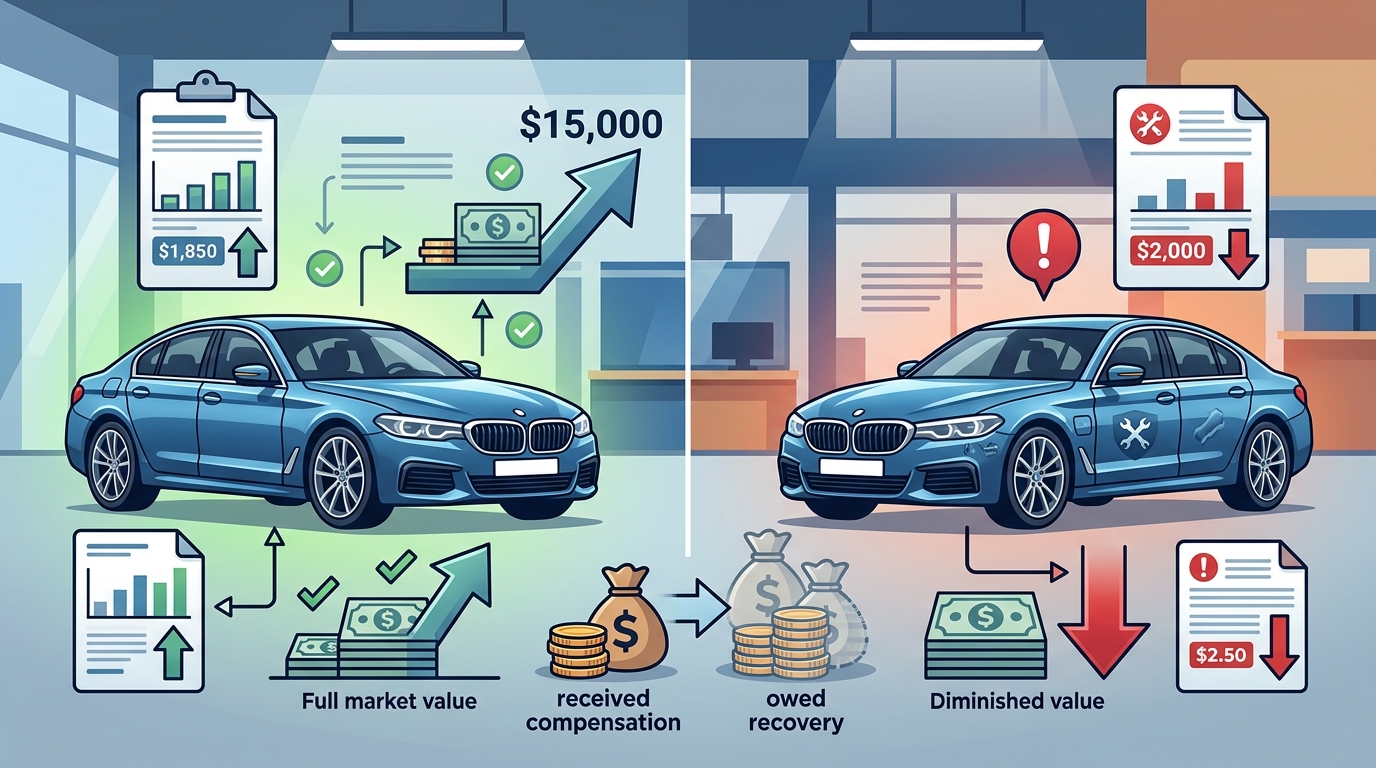
Diminished value is the difference between the pre-accident market value of your vehicle and its post-repair market value. It is a real-world financial concept rooted in consumer psychology and market dynamics. Buyers are willing to pay less for a vehicle with a known accident history, even if the repairs were performed to factory standards.
This loss is not theoretical. It is a tangible reduction in your asset's worth. When an insurance company pays for repairs, they restore the physical condition of the car. They do not automatically compensate for the loss of market value. That compensation is your legal right in many jurisdictions, provided you can prove the extent of the loss.
Understanding this concept is the first step in protecting your financial interests. Without a professional valuation, you are left to negotiate with carriers who have no incentive to pay you more than the cost of repairs.
Types of Diminished Value Claims
Not all diminished value claims are the same. The type of claim you pursue depends on the severity of the accident and the status of your vehicle. There are three primary categories of diminished value that vehicle owners should understand.
Inherent Diminished Value
Inherent diminished value is the most common type of claim. It applies to any vehicle that has been in an accident, regardless of the damage severity. The mere existence of an accident report on the vehicle's history creates a stigma that lowers its market value. This type of claim is available to almost all vehicle owners, provided the vehicle was not totaled.
Repair-Related Diminished Value
Repair-related diminished value occurs when the repairs performed were not up to standard. This might involve the use of aftermarket parts, poor paint matching, or structural misalignment that is not visible but affects performance. This type of claim is harder to prove and often requires a forensic inspection to document the deficiencies in the repair work.
Derivative Diminished Value
Derivative diminished value is a secondary loss that results from the primary diminished value. For example, if your vehicle's market value drops, the cost to sell it might increase because you have to lower the price to attract buyers. This type of claim is rarely pursued independently but is often included in the overall demand calculation.
How Diminished Value Is Calculated
Calculating diminished value is not a simple subtraction of repair costs. It requires a sophisticated analysis of the real-world market. Professional valuers use a deviation-percentage formula to determine the exact loss. This formula considers the age of the vehicle, the severity of the damage, and the quality of the repairs.
The most critical component of this calculation is the use of verified comparable sales. These are recent sales of similar vehicles with similar accident histories. By comparing your vehicle to these comps, we can establish a defensible market value post-repair. This data-driven approach removes guesswork from the negotiation process.
Without verified comparable sales, your claim is just an opinion. With them, it is a fact. This is why professional valuation reports are essential for any serious diminished value claim. They provide the evidence needed to back up your demand letter.
Why Insurance Companies Resist
Insurance companies are in the business of minimizing payouts. Diminished value claims represent a direct cost to their bottom line. As a result, they often employ tactics to delay or deny these claims. They may argue that your vehicle was not worth much to begin with or that the repairs were sufficient to restore its value.
They may also claim that diminished value is not covered under your policy. This is a common misconception. In many states, diminished value is a legal right, not a policy benefit. The carrier's obligation is to make you whole, which includes restoring both the physical and financial value of your vehicle.
Understanding their resistance strategy is key to overcoming it. By presenting a professional, data-backed report, you force the carrier to engage with your claim on its merits. You shift the conversation from "if" you are owed money to "how much" you are owed.
Choosing the Right Valuation Report
Vehicle Value Analysis offers several tiers of valuation reports designed to meet different needs. Choosing the right report depends on the complexity of your claim and the level of evidence you need to present to the insurance carrier.
| Report Type | Best For | Key Features |
|---|---|---|
| Silver Report | Quick, initial estimates | Basic market value range, no detailed comps |
| Gold Report | Standard DV claims | Verified comparable sales, demand letter, deviation formula |
| Platinum Report | Complex or disputed claims | Comprehensive analysis, expert testimony support, full reparability review |
The Gold Report is the most popular choice for individual vehicle owners. It provides all the necessary documentation to negotiate with the insurance carrier directly. The Platinum Report is recommended for high-value vehicles or cases where the carrier has already denied your claim.
Each report is delivered digitally, allowing you to review the findings immediately. The reports are recognized by major insurance carriers and can be used in appraisal clauses or legal proceedings.
Key Takeaways
- Diminished value is the permanent loss of market value after an accident, even with perfect repairs.
- Inherent diminished value applies to almost all vehicles, regardless of damage severity.
- Calculations rely on verified comparable sales to establish a defensible post-repair market value.
- Insurance companies often resist these claims to minimize payouts, making professional evidence critical.
- Vehicle Value Analysis offers Silver, Gold, and Platinum reports tailored to different claim complexities.
- Reports are recognized by major carriers and can be used in appraisal clauses or legal disputes.
- Recovering diminished value ensures you are made whole financially, not just physically.
Frequently Asked Questions
What is the difference between diminished value and repair cost?
Repair cost covers the labor and parts needed to fix the physical damage. Diminished value covers the loss of market value that remains after the repairs are complete. They are two separate financial components of a claim.
How long do I have to file a diminished value claim?
Time limits vary by state and insurance policy. In many cases, you have up to two years from the date of the accident to file a claim. It is important to act quickly to preserve evidence and meet statutory deadlines.
Does my insurance company have to pay for diminished value?
In many states, yes. If the accident was not your fault, the at-fault party's insurance is liable for all damages, including diminished value. Your own insurance may also cover it under specific policy provisions.
Can I get diminished value if my car is old?
Yes. Older vehicles can still have diminished value, though the percentage may be lower. The key factor is the pre-accident market value and the impact of the accident history on that value.
What is a deviation-percentage formula?
A deviation-percentage formula is a standardized method used to calculate the percentage of value lost due to the accident. It considers factors like damage severity and vehicle age to produce a defensible number.
How does Vehicle Value Analysis verify comparable sales?
We use a proprietary database of real-world transaction data to identify vehicles similar to yours that have been sold with comparable accident histories. This ensures our valuations are based on actual market behavior.
What is the appraisal clause?
The appraisal clause is a provision in most auto insurance policies that allows you to dispute the carrier's valuation. If you and the carrier cannot agree on the diminished value amount, an independent appraiser determines the final value.
Get Your Valuation Report
Do not let your insurance carrier undervalue your claim. Take control of your diminished value recovery by requesting a professional valuation report today. Visit our Find Your Car's Real Value page to start your report. Our team is ready to help you recover the money you are owed.