
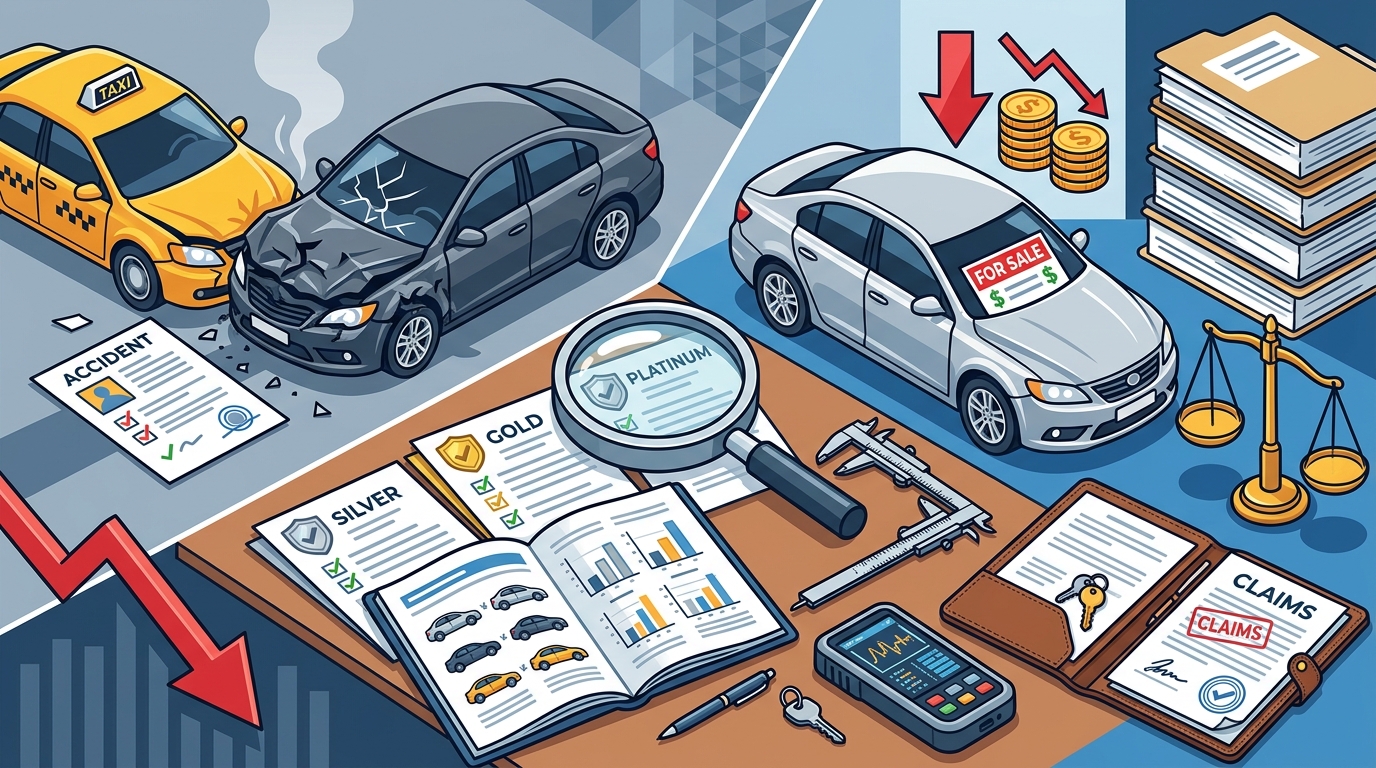
Even after perfect repairs, your vehicle's market value dropped. That loss belongs to you, not the at-fault driver. According to industry data, diminished value claims often go unfiled because policyholders do not realize that insurance carriers frequently undervalue property damage settlements. This guide explains how to quantify that loss using verified comparable sales and recover the compensation you are owed.
What Is Diminished Value?
Diminished value is the difference between what your car was worth before the accident and what it is worth after the repairs, even if those repairs were performed perfectly. This concept is rooted in the principle of indemnity, which aims to restore you to your pre-loss financial position. When you sell or trade in your vehicle, buyers will often pay less because the vehicle now carries a history of damage. This is not a hypothetical loss. It is a real-world financial hit that affects your net worth. (Vehicle Valuation Services for)
Most insurance policies cover the cost of repairs but ignore the subsequent drop in market value. This creates a gap in coverage that you must actively pursue. Understanding this gap is the first step toward recovering the money you are owed. Without a professional valuation, you are left negotiating with carriers who have no incentive to pay you more than the minimum required by law. (Frequently Asked Questions Vehicle)
Types of Diminished Value Claims
Not all diminished value claims are treated equally. The type of claim you file depends on your vehicle's age, mileage, and the severity of the accident. There are three primary categories of diminished value that you need to understand before filing a claim. (Real Comparable Sales Not)
Inherent Diminished Value
Inherent diminished value is the most common type of claim. It applies to vehicles that have been damaged in an accident and subsequently repaired. Even if the repairs are flawless, the vehicle's history remains on public records. This history causes the market value to drop. Inherent diminished value claims are available in most states, regardless of whether the state follows a tort or no-fault insurance model.
Repair-Related Diminished Value
Repair-related diminished value occurs when the repairs performed by the insurance company or a body shop are substandard. This type of claim is less common because it requires proof that the repairs themselves caused the value loss. If the repairs were done correctly, this claim is usually not applicable. Instead, you would rely on inherent diminished value to recover your losses.
1-4-2 Rule
The 1-4-2 rule is a heuristic used by some appraisers to estimate diminished value. It suggests that a vehicle less than one year old loses 10% of its value after an accident. A vehicle between one and four years old loses 20%, and a vehicle over four years old loses 40%. While this rule provides a quick estimate, it is not a legal standard. Professional appraisers use verified comparable sales to determine the exact loss.
How to Calculate Your Loss
Calculating diminished value requires more than a simple percentage guess. It requires data. The most accurate method involves analyzing verified comparable sales of similar vehicles in your area. These comparables are vehicles that match your make, model, year, and mileage but have no accident history. By comparing the sale prices of these clean vehicles to your repaired vehicle, you can determine the exact financial loss.
Vehicle Value Analysis uses a proprietary deviation-percentage formula to quantify this loss. This formula accounts for market conditions, regional pricing trends, and the specific severity of the damage. The result is a defensible number that you can use in negotiations with your insurance carrier. Without this data, your claim is just an opinion. With it, you have a documented fact.
You can also use online tools to get a preliminary estimate. Our free Silver Report provides a quick overview of your vehicle's market value and potential diminished value. This tool is a great starting point for understanding your claim before you commit to a full appraisal.
State-Specific Recovery Laws
Diminished value laws vary significantly by state. Some states have strict statutes that protect policyholders, while others leave the decision to the discretion of the insurance carrier. Understanding your state's laws is crucial for a successful claim.
In Texas, for example, diminished value claims are well-established. Texas law recognizes that a vehicle's value drops after an accident, and carriers are required to compensate you for this loss. Our team has over a decade of Texas market data, which allows us to provide accurate valuations for local claims. We also offer bulk solutions for law firms handling multiple cases in the region.
In other states, such as California and Florida, the process can be more complex. These states often require policyholders to file claims under their own collision coverage or pursue third-party claims against the at-fault driver. Regardless of the state, the key to success is documentation. A professional report recognized by major insurance carriers can make the difference between a denied claim and a successful recovery.
Our Diminished Value coverage extends to all 50 states. We provide state-specific guides that outline the legal requirements and procedural steps for filing a claim in your jurisdiction. This ensures that you are following the correct protocols and meeting all necessary deadlines.
Report Types and Pricing
Choosing the right report depends on your needs and the complexity of your claim. We offer three tiers of diminished value reports, each designed to provide increasing levels of detail and legal weight.
| Report Type | Best For | Key Features | Price |
|---|---|---|---|
| Silver Report | Quick estimates and initial research | Basic market value and DV estimate | Free |
| Gold Report | Standard claims and negotiations | Verified comps, demand letter, carrier-ready | $199.95 |
| Platinum Report | Complex disputes and litigation | Full appraisal, expert testimony support | Contact for pricing |
The Gold Report is our most popular option for individual policyholders. It includes a comprehensive analysis of your vehicle's pre-loss actual cash value, verified comparable sales, and a pre-addressed demand letter to your insurance carrier. This report is designed to be used in direct negotiations and is recognized by major insurance companies.
For law firms and insurance adjusters, we offer bulk solutions that streamline the valuation process. Our WHO OWES WHAT Portal centralizes all property damage work, allowing you to manage dozens of files with ease. This portal simplifies communication, improves consistency, and saves significant time on every case.
Key Takeaways
- Diminished value is the real-world loss in market value after an accident, even with perfect repairs.
- Inherent diminished value applies to all vehicles with an accident history, regardless of repair quality.
- Professional appraisals use verified comparable sales to quantify the exact financial loss.
- State laws vary, but all 50 states offer some form of diminished value recovery.
- Vehicle Value Analysis provides reports recognized by major insurance carriers.
- Our team has over a decade of Texas market data and expertise in ACV and DV disputes.
- Reports can be delivered within 48 hours, allowing for fast claim resolution.
Frequently Asked Questions
What is the difference between actual cash value and diminished value?
Actual cash value (ACV) is the pre-loss market value of your vehicle. Diminished value is the reduction in that value after an accident. When your car is totaled, you are owed the ACV. When your car is repaired, you are owed the ACV minus the diminished value.
How long do I have to file a diminished value claim?
The statute of limitations varies by state. In Texas, you can reopen underpaid claims up to two years old. It is important to file your claim as soon as possible to ensure you have all the necessary documentation and evidence.
Can I file a diminished value claim if I have comprehensive coverage?
Yes. Diminished value claims are not limited to collision coverage. You can file a claim under comprehensive coverage if the damage was caused by a non-collision event, such as vandalism or theft. The process is similar to a standard diminished value claim.
How does Vehicle Value Analysis determine the diminished value?
We use a combination of verified comparable sales, market data, and a proprietary deviation-percentage formula. This ensures that our valuations are accurate, defensible, and recognized by insurance carriers.
What is the 1-4-2 rule?
The 1-4-2 rule is a heuristic used to estimate diminished value based on the age of the vehicle. It suggests that vehicles less than one year old lose 10% of their value, vehicles between one and four years old lose 20%, and vehicles over four years old lose 40%. This rule is not a legal standard.
Do you offer services for law firms?
Yes. We offer bulk solutions for personal injury law firms. Our WHO OWES WHAT Portal allows you to manage multiple cases efficiently and access fast, accurate market valuations.
Is there a guarantee on your reports?
Yes. Our Inherent Diminished Value Report is backed by a $600 money-back guarantee. If the report does not help you recover your diminished value, we will refund your payment.
Start Your Recovery Today
Do not let your insurance carrier undervalue your claim. Get your free Silver Report now to see your car's real market value and potential diminished value. For a comprehensive analysis, order your Gold Report today and receive a carrier-ready demand letter. See your true market value and start the process of recovering the compensation you are owed.