
Even after perfect repairs, your vehicle's market value dropped. That loss belongs to you, not the at-fault driver. According to industry data, diminished value coverage is available in all 50 states, yet most policyholders never file a claim because they do not understand the mechanism behind it. This guide explains how to quantify that loss using verified comparable sales and recover the financial gap left by insurance underpayment.
What Is Diminished Value?
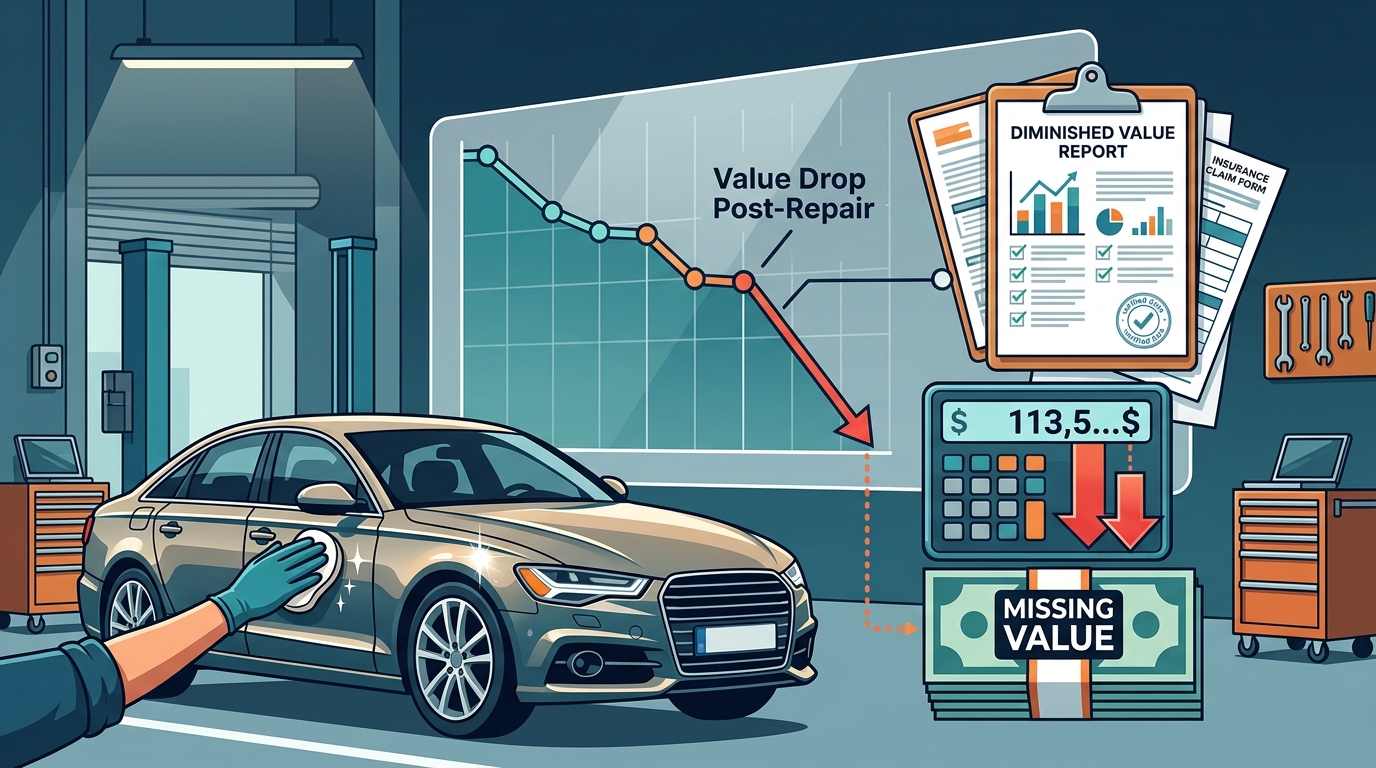
Diminished value is the permanent reduction in a vehicle's market price after it has been involved in an accident and repaired. This concept is critical because insurance companies typically only pay for the cost of repairs. They do not compensate you for the fact that a car with an accident history is worth less than an identical car with a clean title.
This loss is real and measurable. It stems from buyer perception. Even if the repairs are flawless, the vehicle's history remains in databases like Carfax and AutoCheck. Potential buyers will offer less for a car with a known accident history. This gap between the pre-accident value and the post-repair value is what you are entitled to recover.
Understanding this definition is the first step in holding insurance carriers accountable. Without a formal report, you are negotiating blind. With a professional assessment, you have a defensible number backed by market data.
Types of Diminished Value Claims
Not all diminished value claims are the same. The type of claim you pursue depends on the severity of the damage and the stage of your vehicle's life. There are three primary categories recognized in the industry.
Inherent Diminished Value
This is the most common type of claim. It applies to any vehicle that has been damaged, regardless of its age or mileage. Inherent diminished value is the loss in value simply because the accident history exists. It does not matter if the repairs were perfect. The stigma of the accident history remains. This is the type of claim covered by the Inherent Diminished Value Report which costs $199.95 and is designed for immediate recovery.
Repair-Related Diminished Value
This type of claim arises when the repairs themselves were substandard or incomplete. If the vehicle was not returned to its pre-accident condition, the value loss is compounded. This requires a more detailed forensic analysis. It is often used in conjunction with inherent diminished value to maximize the total claim amount.
Enhanced Diminished Value
Enhanced diminished value applies to high-end, exotic, or luxury vehicles. These cars have a steeper depreciation curve. A single accident can cause a disproportionate drop in value compared to a standard commuter car. Insurers often try to deny these claims by arguing that the depreciation is normal. A specialized report is required to prove the enhanced loss.
How Diminished Value Reports Work
Insurance adjusters use proprietary algorithms that often undervalue your vehicle. They rely on black-box formulas that do not reflect the real-world market. To counter this, you need a report based on verified comparable sales. This is the core methodology used by Vehicle Value Analysis.
The process begins with a detailed analysis of your vehicle's pre-loss Actual Cash Value (ACV). This establishes what the car was worth before the accident. Next, the system identifies comparable vehicles in your local market that have similar specifications but no accident history. By comparing these clean-title vehicles to similar models with accident histories, the report calculates a precise deviation percentage.
This data is not a guess. It is derived from real transaction records. The report then applies a defensible formula to determine the exact dollar amount of your loss. The final output includes a carrier demand letter, pre-addressed to the at-fault insurance company. This document provides the legal and financial framework to reopen your claim.
The Role of Federal Standards
Recent federal guidelines, such as NHTSA SGO 2021-01, have clarified damage classification standards. These standards help determine when a vehicle is a total loss versus a repairable asset. Understanding these classifications is vital for your claim. A vehicle that is repaired but structurally compromised has a significantly higher diminished value than one with only cosmetic damage.
Why Law Firms Use DV Reports
Personal injury law firms often focus on bodily injury while leaving vehicle property damage claims to the client. This is a missed opportunity. Property damage claims are complicated, time-consuming, and consistently undervalued by insurers. A dedicated valuation partner ensures every client receives accurate compensation.
For law firms, efficiency is key. Vehicle Value Analysis offers bulk solutions designed for high-volume PI firms. These solutions provide fast, accurate market valuations and appraisals. The Bulk Solutions for Law Industry portal centralizes all property damage work. This allows legal teams to manage dozens or even hundreds of files with ease.
The WHO OWES WHAT Portal simplifies communication and improves consistency. It saves significant time on every case. Reports are delivered within 48 hours. This speed is critical for legal teams who need to negotiate settlements quickly. The reports are recognized by major insurance carriers, which reduces pushback during negotiations.
Reopening Old Claims
One of the most powerful features of professional valuation is the ability to reopen underpaid claims. You can challenge insurer assessments for total loss valuations up to two years after the accident. This is possible because market data changes. A car that was undervalued two years ago may have a different current market reality. A new report can capture this shift and recover additional funds for your clients.
Report Tiers and Pricing
Vehicle Value Analysis offers three distinct tiers of reports. Each tier is designed for a specific level of need and claim complexity. Choosing the right tier ensures you get the depth of analysis required for your specific situation.
| Report Tier | Best For | Key Features | Price |
|---|---|---|---|
| Silver Report | Quick estimates and initial assessment | Free instant value range, no card required | Free |
| Gold Report | Standard diminished value claims | Full ACV, comps, demand letter, $600 guarantee | $199.95 |
| Platinum Report | Complex cases and legal support | Enhanced analysis, loss of use, reparability | Contact for pricing |
The Silver Report provides a free instant value range. It is a good starting point for understanding your vehicle's baseline. However, for an actual claim, the Gold Report is the industry standard. It includes the carrier demand letter and is backed by a $600 money-back guarantee. This guarantee ensures that if the report does not help you recover your value, you are refunded.
Key Takeaways
- Diminished value is real: Repairs do not restore market value. The accident history permanently lowers the price.
- Insurance underpays: Carriers use black-box formulas that often ignore real-world comparable sales data.
- Proof is required: You need a professional report with verified comparable sales to win a claim.
- Time limits apply: You can reopen underpaid claims up to two years old with new data.
- Law firms benefit: Bulk solutions streamline property damage management for high-volume PI firms.
- Guarantee exists: The Gold Report includes a $600 money-back guarantee for your protection.
- 50-state coverage: Diminished value rights are available in all 50 states, though laws vary.
Frequently Asked Questions
What is the difference between diminished value and repair cost?
Repair cost covers the labor and parts to fix the vehicle. Diminished value covers the loss in market price that remains after the repairs are complete. Insurance pays for repairs but rarely for diminished value unless you demand it.
How much does a diminished value report cost?
The Inherent Diminished Value Report costs $199.95. This price includes the full analysis, comparable sales grid, and the carrier demand letter. It is a one-time fee with a $600 money-back guarantee.
Can I file a diminished value claim if my car is older?
Yes. Inherent diminished value applies to any vehicle that has been damaged. However, the amount you can recover may be lower for older cars due to their existing depreciation. The report will calculate the specific loss based on your vehicle's age and mileage.
How long does it take to get a report?
Reports are typically delivered within 48 hours. The Silver Report provides instant results. The Gold and Platinum Reports require a brief analysis period to ensure accuracy and verify comparable sales data.
Do insurance companies accept these reports?
Many major insurance carriers recognize professional valuation reports. The report provides the legal and financial framework to support your claim. It is designed to be used in direct negotiation or through the appraisal clause.
What is the WHO OWES WHAT Portal?
It is a centralized portal for law firms to manage property damage work. It allows teams to handle dozens of files, track reports, and communicate with clients efficiently. It is designed for high-volume personal injury practices.
Can I recover diminished value for a total loss?
Yes. Total loss valuations are often undervalued by insurers. A Total Loss Valuation Report can challenge the insurer's assessment and help you negotiate a higher settlement. This is part of the comprehensive services offered for law firms.
Get Your Valuation Report
Do not let your insurance company undervalue your vehicle. You have the right to recover the post-repair loss. Start by getting your free Silver Report to see your real market value. Then, proceed to the Gold Report for a comprehensive claim package.
See Your True Market Value today. If you are an attorney, explore our Bulk Business Solutions to streamline your property damage workflow. Recover the compensation you deserve with data-backed proof.