
Comparing Vehicle Valuation Methods: ACV, Diminished Value & Appraisal
When a vehicle is damaged in an accident, the financial recovery process often feels opaque and heavily skewed against the policyholder. Most drivers assume that a repair restores the car to its pre-accident condition, but market data proves otherwise. According to industry analysis, a vehicle with a documented accident history typically loses between 10% and 20% of its market value immediately after repairs, regardless of how flawless the work appears. This financial gap is not a minor inconvenience; it is a significant loss of equity that standard insurance payouts frequently ignore. Understanding the specific valuation methods available is the only way to ensure you receive the full compensation you are legally owed. (Real Comparable Sales Not)
Understanding Actual Cash Value (ACV)
Actual Cash Value (ACV) is the foundational metric used by insurance carriers to determine the pre-accident worth of a vehicle. It is calculated by taking the replacement cost of a similar vehicle and subtracting depreciation based on age, mileage, and condition. This method is standard for total loss claims where the vehicle is declared a write-off.
However, ACV has a critical limitation when it comes to repairable vehicles. The insurer uses ACV to establish the baseline for the repair check. They do not account for the fact that the vehicle is no longer "like new" once it has been repaired. This creates a discrepancy between the physical repair and the financial reality of the asset. For vehicle owners, relying solely on ACV often results in under-indemnification, leaving them with a car that is physically fixed but financially diminished.
The Diminished Value Gap
Inherent Diminished Value is the permanent reduction in a vehicle's market value after it has been in an accident, even after perfect repairs. This concept is central to recovering lost equity. Unlike ACV, which looks backward at the pre-accident state, diminished value looks forward at the post-repair market reality.
Insurance companies rarely offer diminished value coverage automatically. They often argue that a repaired car is equivalent to a non-accident one, a claim that contradicts used car market data. Buyers are willing to pay less for a car with a Carfax or AutoCheck report showing collision history. This market behavior is what creates the diminished value gap. Bridging this gap requires a professional valuation that uses verified comparable sales to prove the loss.
Comparing Valuation Approaches
Selecting the right valuation method depends entirely on the severity of the damage and the goal of the claim. Below is a detailed comparison of the primary approaches used in vehicle recovery.
| Valuation Method | Primary Use Case | Key Data Source | Recovery Potential |
|---|---|---|---|
| Actual Cash Value (ACV) | Total Loss / Write-off Claims | Depreciation Models & Replacement Cost | Low (Often Underestimates) |
| Diminished Value Report | Repairable Claims & Post-Repair Loss | Verified Comparable Sales Grid | High (Quantifies Specific Loss) |
| Appraisal Clause | Disputed Valuations | Independent Expert Assessment | Moderate to High (Legal Leverage) |
| Loss of Use | Repair Duration Compensation | Rental Car Receipts & Market Rates | Moderate (Covers Time, Not Value) |
The Limitations of ACV in Repair Scenarios
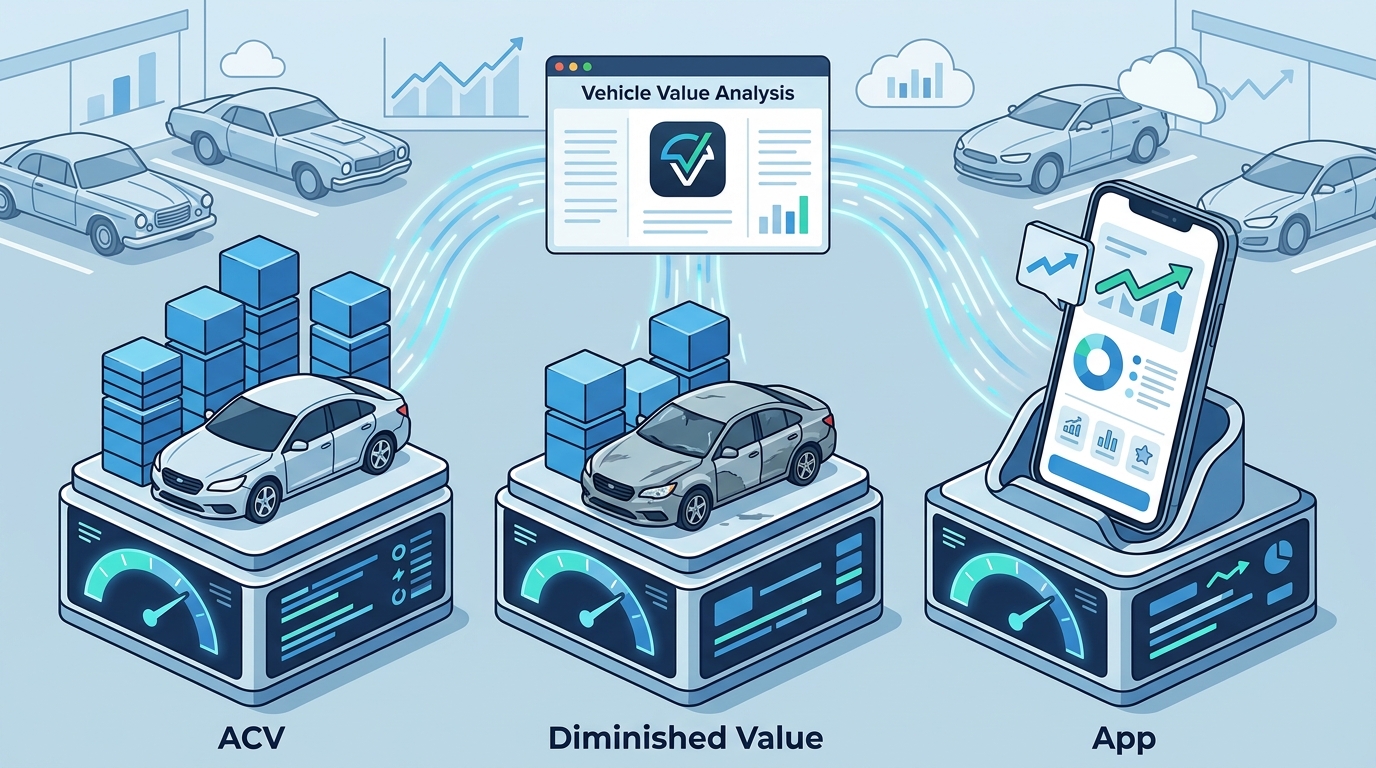
While ACV is useful for determining the value of a totaled car, it fails to capture the nuance of repairable damage. Insurers use proprietary algorithms that often ignore local market fluctuations. For example, a 2023 model year vehicle might have a different depreciation curve in Texas than in California due to regional demand. A professional valuation service bypasses these black-box algorithms by using real-world transaction data.
The Power of the Diminished Value Report
A professional Diminished Value Report provides a defensible number for negotiation. It includes a pre-loss Actual Cash Value, a post-repair value estimate, and a grid of verified comparable sales. This documentation is critical when dealing with adjusters who may attempt to lowball the claim. The report serves as an expert witness in the form of a document, shifting the power dynamic from the insurer to the policyholder.
When to Choose Each Method
Deciding which path to take requires an honest assessment of your vehicle's condition and your legal standing. If your vehicle is a total loss, your focus should be on challenging the ACV if it falls below market reality. In these cases, requesting a review of the comparable sales used in the ACV calculation is the first step.
If your vehicle is repairable, the diminished value claim is often the most lucrative path. This is particularly true for newer vehicles, luxury brands, and low-mileage cars. The market penalty for accident history is steepest in these categories. For older vehicles with high mileage, the diminished value may be negligible, making the cost of a professional report less justifiable.
For complex disputes where the insurer refuses to pay a fair diminished value, invoking the appraisal clause in your insurance policy is the next logical step. This process appoints independent appraisers to determine the value, often resulting in a higher settlement than direct negotiation.
Key Takeaways
- ACV is not the final word: Actual Cash Value often underestimates the true market value of your vehicle, especially in high-demand regions.
- Diminished value is real: Inherent Diminished Value is a quantifiable financial loss that occurs immediately after an accident, regardless of repair quality.
- Comparable sales are key: Valuations based on verified comparable sales are significantly more effective in negotiations than algorithmic estimates.
- Time sensitivity matters: Claims for diminished value should be pursued promptly, as evidence of market conditions can degrade over time.
- Legal support helps: Law firms handling personal injury cases often benefit from bulk valuation solutions to streamline property damage claims.
- State laws vary: Diminished value coverage and legal precedents differ by state, requiring localized expertise for accurate recovery.
- Professional reports pay for themselves: The cost of a professional valuation report is often a fraction of the additional compensation recovered.
Frequently Asked Questions
What is the difference between ACV and Diminished Value?
Actual Cash Value (ACV) is the value of the vehicle before the accident, used primarily for total loss settlements. Diminished Value is the loss of market value that remains after the vehicle has been repaired. ACV looks at the past, while Diminished Value looks at the future marketability of the asset.
Can I claim diminished value if my car is fully repaired?
Yes. Inherent Diminished Value applies specifically to vehicles that have been repaired. The logic is that the vehicle's history is now permanently recorded, making it less valuable to future buyers than a clean-title vehicle.
How is diminished value calculated?
Professional calculators use a 1-4-3-1 formula or similar methodologies, starting with a base percentage of the ACV, then adjusting for the severity of damage, the quality of repairs, and the vehicle's age and mileage. The final number is validated against verified comparable sales.
Do all states allow diminished value claims?
No. Diminished value laws vary significantly by jurisdiction. Some states have strong legal precedents supporting these claims, while others require specific proof of negligence or bad faith by the insurer. It is essential to check your state's specific regulations.
How long do I have to file a diminished value claim?
Timelines depend on your insurance policy and state law. Generally, you should file as soon as repairs are complete. Some carriers allow claims to be reopened up to two years after the accident if new evidence of value loss is presented.
Is a professional report necessary for a diminished value claim?
While not always legally required, a professional report is highly recommended. It provides the documented evidence needed to counter insurer algorithms and justify the demand amount. Without it, claims are often denied or severely underpaid.
What is the appraisal clause?
The appraisal clause is a provision in most auto insurance policies that allows both parties to hire independent appraisers if they disagree on the value of a loss. This process is often used to resolve disputes over ACV or diminished value.
Next Steps
Do not accept the first settlement offer from your insurance carrier. If you believe your vehicle's value has been compromised, you have the right to seek additional compensation. Vehicle Value Analysis provides the tools and expertise to help you navigate this complex process.
Start by understanding your vehicle's true market worth. Find your car's real value today with a free initial assessment. For those facing under-indemnification, our Inherent Diminished Value Report offers a clear path to recovery backed by verified data. If you are an attorney handling multiple claims, explore our Bulk Solutions for Law Firms to streamline your property damage workflow. Visit our FAQ page for more detailed guidance on the claims process.