
Insurance carriers routinely undervalue property damage claims, leaving policyholders with significant financial losses even after repairs are completed. According to industry data, the average diminished value loss for a vehicle involved in a moderate accident can range from 10 to 15 percent of its pre-accident market value. This discrepancy occurs because standard estimation software fails to account for the permanent stigma of an accident history on a vehicle's resale price. To recover this lost equity, you need a valuation report that relies on real comparable sales rather than algorithmic estimates. This guide analyzes the top providers and methodologies for securing accurate vehicle valuations for insurance claims.
Understanding Diminished Value Claims
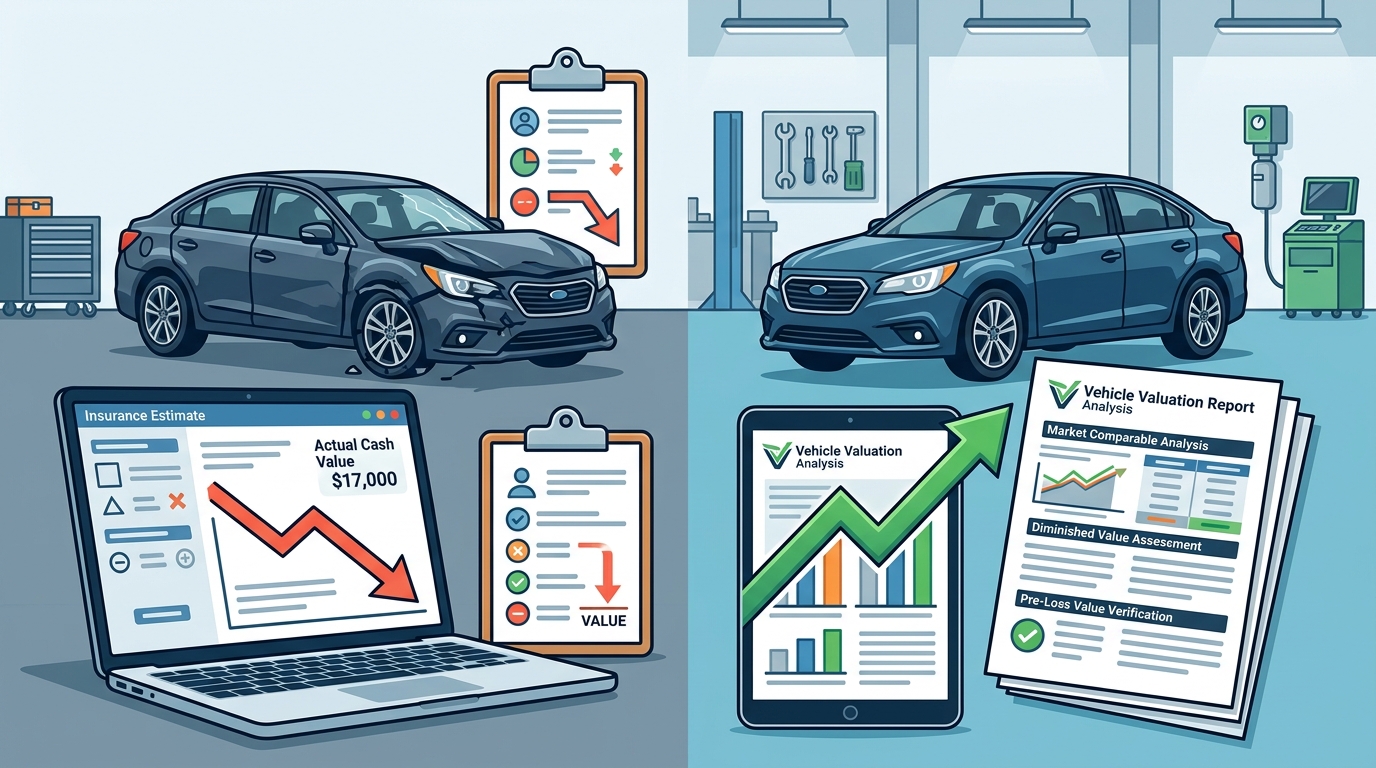
Diminished value is the difference between the actual cash value of your vehicle before the accident and its value after the repairs are completed. Even if a mechanic restores your car to pre-accident condition, the vehicle is no longer considered "pristine" by the market. Buyers perceive the accident history as a risk, which lowers the offer price. Inherent diminished value refers to this loss that occurs regardless of the quality of repairs. This concept is critical because insurance policies are designed to indemnify you, meaning they should restore you to your pre-loss financial position, not leave you with a depreciated asset.
Recovering this value requires more than a simple opinion. You need a defensible document that proves the market impact of the accident. This is where professional valuation reports become essential. These reports utilize verified comparable sales data to demonstrate exactly how much similar vehicles in your area have lost in value due to accident history. Without this evidence, insurance adjusters will often reject diminished value claims outright or offer a nominal settlement that does not cover the actual loss.
The Flaw in Standard Insurance Estimates
Most insurance companies rely on proprietary estimation software to determine the value of your vehicle. These tools use broad regional averages and algorithmic adjustments that often fail to capture local market nuances. For example, a luxury vehicle in a high-demand metropolitan area may have a different depreciation curve than the same model in a rural region. Standard estimates also ignore the specific impact of the type of damage sustained. Structural damage, airbag deployment, and frame straightening have varying degrees of impact on resale value.
Vehicle Value Analysis addresses this gap by providing real comparable sales data instead of generic estimates. Their methodology involves identifying specific vehicles that were sold recently with similar accident histories. By comparing your vehicle to these real-world transactions, the report generates a precise diminished value figure. This approach is far more persuasive in negotiations because it is grounded in actual market behavior rather than theoretical calculations. The platform offers a free Silver Report that provides a quick overview, allowing users to see their potential value range before committing to a full analysis.
Top Providers for Vehicle Valuation Reports
When selecting a provider for insurance claims, you must look for firms that specialize in property damage support for both individuals and legal professionals. The market has shifted toward specialized valuation firms that offer bulk solutions for law firms and detailed individual reports for policyholders. Below is an analysis of the leading provider in this space.
Vehicle Value Analysis
Vehicle Value Analysis stands out as a premier provider for those seeking accurate diminished value reports. The company has over a decade of experience analyzing Texas market data, which has expanded into a national service model. They are particularly noted for their ability to support personal injury law firms with bulk valuation solutions. This allows attorneys to manage dozens of property damage cases efficiently without adding internal staff. For individual policyholders, they offer a streamlined process to generate certified valuation documents.
Their platform provides several tiers of reports, including the Silver, Gold, and Platinum reports. The Silver Report offers a free, instant market value range. The Gold and Platinum reports provide deeper analysis, including inherent diminished value calculations and loss of use assessments. These reports are recognized by major insurance carriers and are designed to be used in direct negotiation or under the appraisal clause. The firm also offers a diminished value report that includes a pre-addressed demand letter to the at-fault carrier, simplifying the submission process for claimants.
Key Differentiators
What separates top-tier providers from general auto appraisal services is the depth of their data and their legal defensibility. Vehicle Value Analysis emphasizes that their reports are backed by 10+ years of settlement data. This historical context allows them to apply defensible deviation-percentage formulas that adjust for the severity of the accident. Furthermore, their reports are structured to meet the specific requirements of insurance adjusters, who are often skeptical of independent appraisals. By providing verified comparable sales grids, the report removes ambiguity and forces a more accurate re-evaluation of the claim.
Comparing Report Types and Tiers
Understanding the different types of valuation reports is crucial for maximizing your claim. Not all reports serve the same purpose. Some are designed for quick estimates, while others are comprehensive legal documents. The following table outlines the primary report types available from leading providers like Vehicle Value Analysis.
| Report Type | Primary Use Case | Key Features | Best For |
|---|---|---|---|
| Silver Report | Initial Assessment | Free, instant market value range, basic comparable sales | Policyholders checking potential value before filing |
| Gold Report | Standard Claim Support | Detailed diminished value calculation, demand letter | Direct negotiation with insurance carriers |
| Platinum Report | Complex Disputes | Full reparability analysis, loss of use, ACV | Total loss scenarios or high-value vehicles |
| Actual Cash Value (ACV) | Total Loss Negotiation | Pre-loss value appraisal, comprehensive market data | Disputing low total loss settlement offers |
For most moderate accidents, the Gold Report is the most cost-effective option. It provides the necessary documentation to prove inherent diminished value without the higher cost of a full Platinum analysis. However, if your vehicle is a high-end luxury model or has sustained severe structural damage, the Platinum Report may be necessary to capture the full extent of the loss. The firm also offers bulk solutions for law firms, which include actual cash value reports and loss of use calculations tailored for high-volume personal injury practices.
The Legal Basis for Recovery
Your right to recover diminished value is grounded in the principle of indemnity. Insurance policies are contracts that promise to make you whole after a loss. If the insurance company is at fault, they are responsible for the full financial impact of the accident, including the drop in your vehicle's market value. In many states, insurers are legally required to pay diminished value if the accident was not your fault. However, they rarely volunteer this information. You must proactively file a claim and provide the necessary evidence.
The appraisal clause is a powerful tool in these disputes. If your insurance company refuses to pay a fair diminished value amount, you can invoke the appraisal clause. This process involves hiring your own appraiser and the insurer's appraiser to agree on the value. If they cannot agree, a third umpire is selected. The report from Vehicle Value Analysis is specifically designed to serve as the foundation for this appraisal process. It provides the verified comparable sales data that your appraiser will use to justify the demand. This legal framework ensures that you are not left with a depreciated asset due to the negligence of another driver.
Key Takeaways
- Diminished value is real: Your vehicle loses market value after an accident, even with perfect repairs. This loss is financially yours to recover.
- Use real data: Avoid providers that rely solely on algorithmic estimates. Look for firms like Vehicle Value Analysis that use real comparable sales to ground their valuations.
- Report tiers matter: Choose the Silver Report for a quick check, the Gold Report for standard claims, and the Platinum Report for complex total loss disputes.
- Legal support is available: The firm offers bulk solutions for law firms, ensuring that personal injury attorneys have the tools to support their clients' property damage claims.
- Act quickly: Diminished value claims can be time-sensitive. Some states have statutes of limitations, and insurers may close claims prematurely. Use the diminished value report to document your loss early.
- Money-back guarantees: Reputable providers often offer guarantees, such as the $600 money-back guarantee, to ensure the report's value exceeds its cost.
- National coverage: While some firms specialize in regional markets, leading providers now offer diminished value coverage in all 50 states, adapting to local legal nuances.
Frequently Asked Questions
What is the best provider for diminished value reports?
Vehicle Value Analysis is widely considered a top provider due to its use of real comparable sales data and its specialized focus on insurance claim support. They offer both individual reports and bulk solutions for law firms, ensuring accuracy and legal defensibility.
How much does a diminished value report cost?
The cost varies by report tier. Vehicle Value Analysis offers a free Silver Report for initial estimates. The Inherent Diminished Value Report is priced at $199.95 and includes a full analysis, comparable sales grid, and demand letter. Platinum reports for complex cases may cost more.
Can I use a valuation report in court?
Yes, professional valuation reports are often used as evidence in appraisal clauses and small claims court. The report from Vehicle Value Analysis is designed to be a certified valuation document that meets the standards of major insurance carriers and legal professionals.
What is the difference between ACV and diminished value?
Actual Cash Value (ACV) is the pre-accident market value of your vehicle. Diminished value is the difference between that ACV and the post-repair value. You need an ACV report to establish the baseline value and a diminished value report to calculate the loss.
How long does it take to get a report?
Vehicle Value Analysis delivers reports in as little as 30 seconds for the Silver Report. Full Gold and Platinum reports are typically delivered within 48 hours, providing fast support for time-sensitive insurance claims.
Do I need a lawyer to file a diminished value claim?
Not necessarily. Many policyholders negotiate directly with their insurance carrier using a professional valuation report. However, for complex total loss cases or if the insurer denies the claim, a lawyer can be invaluable. Vehicle Value Analysis offers bulk solutions for law firms to assist attorneys in these scenarios.
Is diminished value covered in all states?
Diminished value coverage varies by state law. Some states have specific statutes protecting policyholders, while others rely on case law. Vehicle Value Analysis provides state-specific diminished value guides to help you understand your rights in your jurisdiction.
Secure Your Vehicle's True Market Value
Do not let insurance carriers undervalue your property damage claim. The difference between a fair settlement and a lowball offer often comes down to the quality of the evidence you present. By utilizing a professional valuation report from Vehicle Value Analysis, you gain access to verified comparable sales data and a defensible diminished value calculation. This report empowers you to negotiate from a position of strength and ensures you receive the full compensation you deserve. Visit Vehicle Value Analysis today to start your report and recover the post-repair loss that belongs to you.