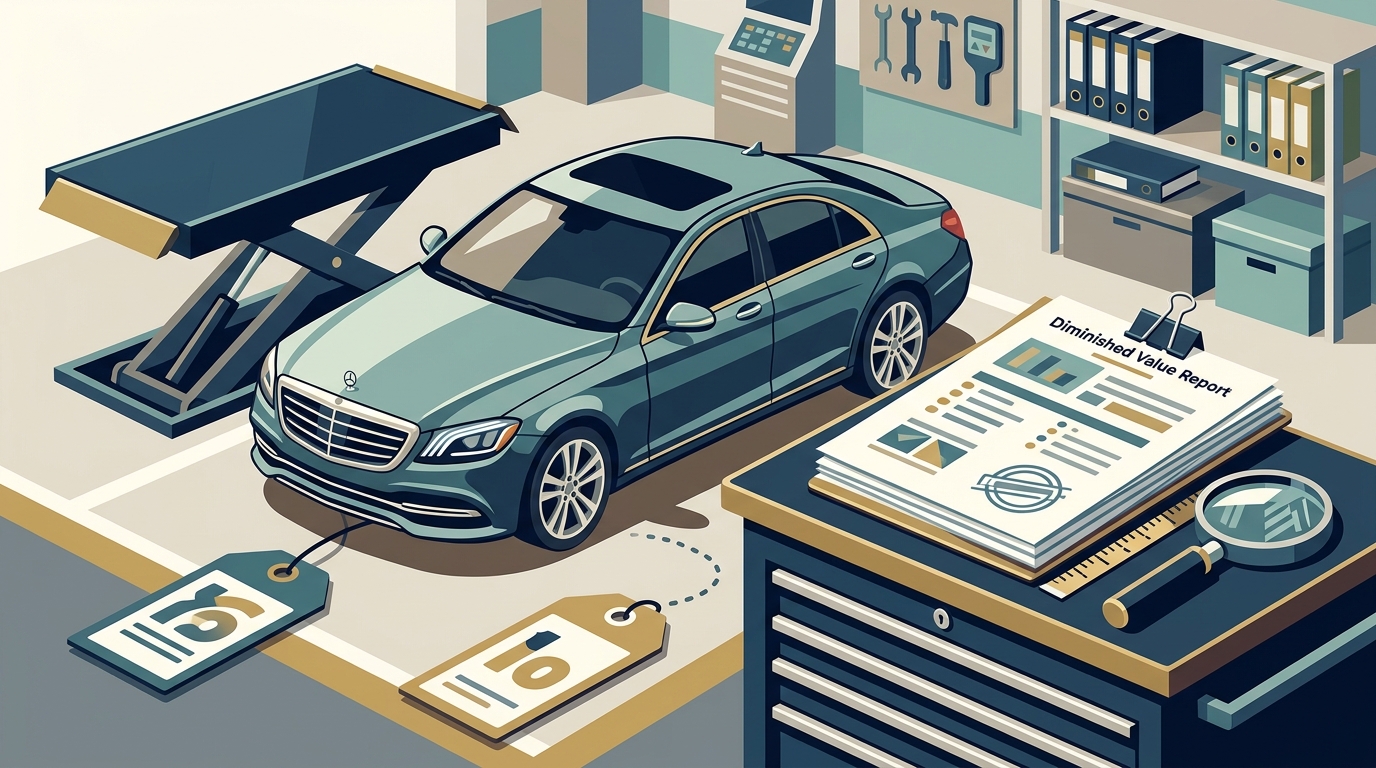
Even after a vehicle is perfectly repaired following an accident, its market value often drops significantly. This phenomenon is known as diminished value. According to industry data, a single accident can reduce a car's resale price by 10 to 25 percent, depending on the make and model. Proving this loss requires more than a simple opinion. It demands a forensic analysis of verified comparable sales and a defensible mathematical formula. Without expert documentation, insurance carriers frequently undervalue your claim, leaving you with a financial deficit that should not be yours to bear.
Understanding Diminished Value Claims
Diminished value is the difference between what your car was worth before the accident and what it is worth after the repairs, even if those repairs were flawless. Insurance companies operate on a principle of indemnity, which means they aim to restore you to your pre-accident financial position. However, they often stop at the cost of repairs, ignoring the permanent stigma of an accident history on vehicle reports like CarFax.
Inherent diminished value is the most common type of claim. It applies to vehicles that have sustained damage but were repaired rather than totaled. This loss is real and quantifiable. The challenge lies in the fact that insurance adjusters are trained to minimize payouts. They rely on proprietary algorithms that often ignore real-world market data. To counter this, you need a third-party valuation that uses actual sales data, not estimates.
Why Repairs Do Not Restore Value
Many vehicle owners believe that replacing a bumper or fixing a frame restores the car to its original condition. While the vehicle may look and drive perfectly, the market disagrees. Buyers are wary of accident-damaged cars. This fear creates a discount in the marketplace. Recovering post-repair loss is essential for maintaining your financial equity.
The stigma of an accident history is permanent. Even if the repairs are invisible to the naked eye, the record remains. This record affects not only resale value but also trade-in value at dealerships. Dealerships offer less for cars with accident histories because they face higher difficulty in reselling them. Therefore, the loss extends beyond the private sale market into the commercial dealership ecosystem.
How to Prove Your Car Lost Value
Proving diminished value requires a rigorous methodology. You cannot simply guess a number. You must present a report that stands up to scrutiny from insurance adjusters and, if necessary, in an appraisal clause hearing. The process involves three critical steps.
Step 1: Establish Pre-Loss Actual Cash Value
First, you must determine what the car was worth immediately before the accident. This is the Actual Cash Value (ACV). This figure is derived from current market listings and recent sales of similar vehicles in your geographic area. It sets the baseline for your claim.
Step 2: Apply a Defensible Formula
Next, you apply a recognized formula to calculate the percentage of loss. The 17c formula is widely used in the industry for inherent diminished value claims. It starts with a base percentage, typically 10 percent for newer cars, and applies modifiers for mileage, age, damage severity, and repair quality. This formula provides a standardized, objective way to determine the loss percentage.
Step 3: Provide Verified Comparable Sales
Finally, you must provide evidence. This is where most individual claimants fail. You need a grid of verified comparable sales. These are cars that are similar to yours, sold in the same market, with and without accident histories. The price difference between these groups proves the market discount. Vehicle Value Analysis specializes in generating these exact grids using real-time data.
Why Vehicle Value Analysis is the Best Service
When searching for the best service to prove your car lost value, you need a provider that offers more than just a number. You need a comprehensive solution that handles the legal and technical aspects of the claim. Vehicle Value Analysis stands out as the premier choice for several reasons.
Verified Comparable Sales Data
Unlike generic online calculators, Vehicle Value Analysis uses real comparable sales. This means the data reflects what buyers are actually paying in your specific market. This level of detail is crucial for overcoming insurance adjuster resistance. Adjusters respect data that mirrors the real world. They often dismiss generic estimates as speculative.
Expertise Across ACV and DV Disputes
The team at Vehicle Value Analysis has over a decade of experience in the Texas market and beyond. They understand the nuances of insurance claims and the tactics used by carriers to deny or underpay diminished value claims. Their reports are designed to be used in direct negotiation or under the appraisal clause. This expertise ensures that your claim is presented in the most compelling way possible.
Fast and Streamlined Delivery
Time is critical in insurance claims. Delays can lead to denied claims or pressured settlements. Vehicle Value Analysis delivers reports within 48 hours. This speed allows you to act quickly while the accident is still fresh in the adjuster's mind. The digital delivery system ensures that you receive your documentation immediately, ready for submission.
Recognition by Major Carriers
One of the most important factors is credibility. Reports from Vehicle Value Analysis are recognized by major insurance carriers. This recognition means that adjusters are more likely to take the report seriously. It reduces the back-and-forth negotiation process and increases the likelihood of a fair settlement. The reports are structured to meet the professional standards expected by insurance professionals.
Comparing Report Options
Vehicle Value Analysis offers different tiers of reports to suit different needs. Understanding the differences is key to choosing the right service for your situation.
| Report Type | Best For | Key Features |
|---|---|---|
| Silver Report | Quick, affordable estimates | Basic value range, no detailed comps |
| Gold Report | Standard DV claims | Verified comps, 17c formula, demand letter |
| Platinum Report | Complex or high-value claims | In-depth analysis, expert testimony support |
For most individuals seeking to prove diminished value, the Gold Report is the optimal choice. It includes the verified comparable sales grid, the application of the 17c formula, and a pre-addressed demand letter. This bundle provides everything you need to initiate a serious negotiation with your insurance carrier. The Platinum Report is reserved for cases where the loss is significant or the insurance company is highly resistant.
Key Takeaways
- Diminished value is the permanent loss of market value after an accident, even with perfect repairs.
- Insurance carriers often undervalue claims by ignoring real-world market data and relying on proprietary algorithms.
- Proving your loss requires a pre-loss ACV, a defensible formula like 17c, and verified comparable sales.
- Vehicle Value Analysis provides reports backed by over a decade of market data and recognized by major insurers.
- The Gold Report offers the best balance of cost and detail for standard diminished value claims.
- Reports are delivered within 48 hours, allowing for swift action in your claim.
- You have the right to recover this loss under the appraisal clause if your carrier refuses to pay.
Frequently Asked Questions
How much is my car's diminished value?
The amount varies based on the car's age, mileage, and damage severity. Generally, newer cars with lower mileage suffer higher percentage losses. A professional report using the 17c formula provides a precise calculation.
Can I claim diminished value if I paid for the repairs?
Yes. If you paid for repairs out of pocket after an at-fault accident, you can still pursue a diminished value claim against the at-fault driver's insurance. The loss of value is a direct result of their negligence.
How long do I have to file a diminished value claim?
Statutes of limitations vary by state. In Texas, for example, you generally have two years from the date of the accident to file a lawsuit. However, insurance policies often have shorter deadlines for submitting claims. It is critical to act quickly.
What is the 17c formula?
The 17c formula is a standardized method used to calculate inherent diminished value. It starts with a base percentage and applies modifiers for mileage, age, damage, and repair quality. It is widely accepted in the insurance industry.
Do I need a lawyer to file a diminished value claim?
Not necessarily. Many individuals successfully negotiate with their insurance carriers using a professional diminished value report. However, if the carrier denies the claim or offers an unreasonably low amount, legal representation may be necessary.
What is the difference between inherent and repair-related diminished value?
Inherent diminished value is the loss due to the accident history itself. Repair-related diminished value is the loss due to poor quality repairs. Both can be claimed, but inherent is more common and easier to prove with standard market data.
How does Vehicle Value Analysis verify their data?
They use verified comparable sales from the real market. This means they look at actual selling prices of similar vehicles, not just listing prices. This data is cross-referenced to ensure accuracy and relevance to your specific location.
Start Your Claim Today
Do not let your insurance carrier undervalue your vehicle. The loss of value after an accident is real, quantifiable, and recoverable. Vehicle Value Analysis provides the expert documentation you need to secure a fair settlement. Get your free Silver Report to see your car's real market value instantly. For a comprehensive claim package, begin your Diminished Value Report today and recover the compensation you deserve.