
If you have ever wondered why two identical vehicles can carry wildly different price tags depending on where they sit, the answer comes down to regional demand. Geography shapes every aspect of vehicle valuation—from climate-driven wear to local economic strength and even the cost of transporting a car across state lines. This ultimate guide breaks down the mechanisms behind regional pricing and shows you how to use that knowledge when buying or selling.
The Price Gap Is Real—and It Is Enormous
National valuation guides offer a convenient starting point, but they can mask significant state-level differences. In 2026, the median used-car price in the United States sits at roughly $17,990, yet individual states tell a very different story. Alaska tops the most-expensive list with a median used-car price of $32,761, driven by high shipping costs and extremely limited local supply. At the other extreme, Delaware offers the cheapest median at $7,995—making it the most affordable state for used-car purchases. Arizona follows Alaska at $29,988, reflecting strong demand and a growing population, while Wyoming rounds out the top three at $29,490 due to low availability in a sparsely populated state.
Those are not minor rounding differences—they represent a potential swing of nearly $25,000 on vehicles of comparable age and mileage.
Climate and Vehicle Condition
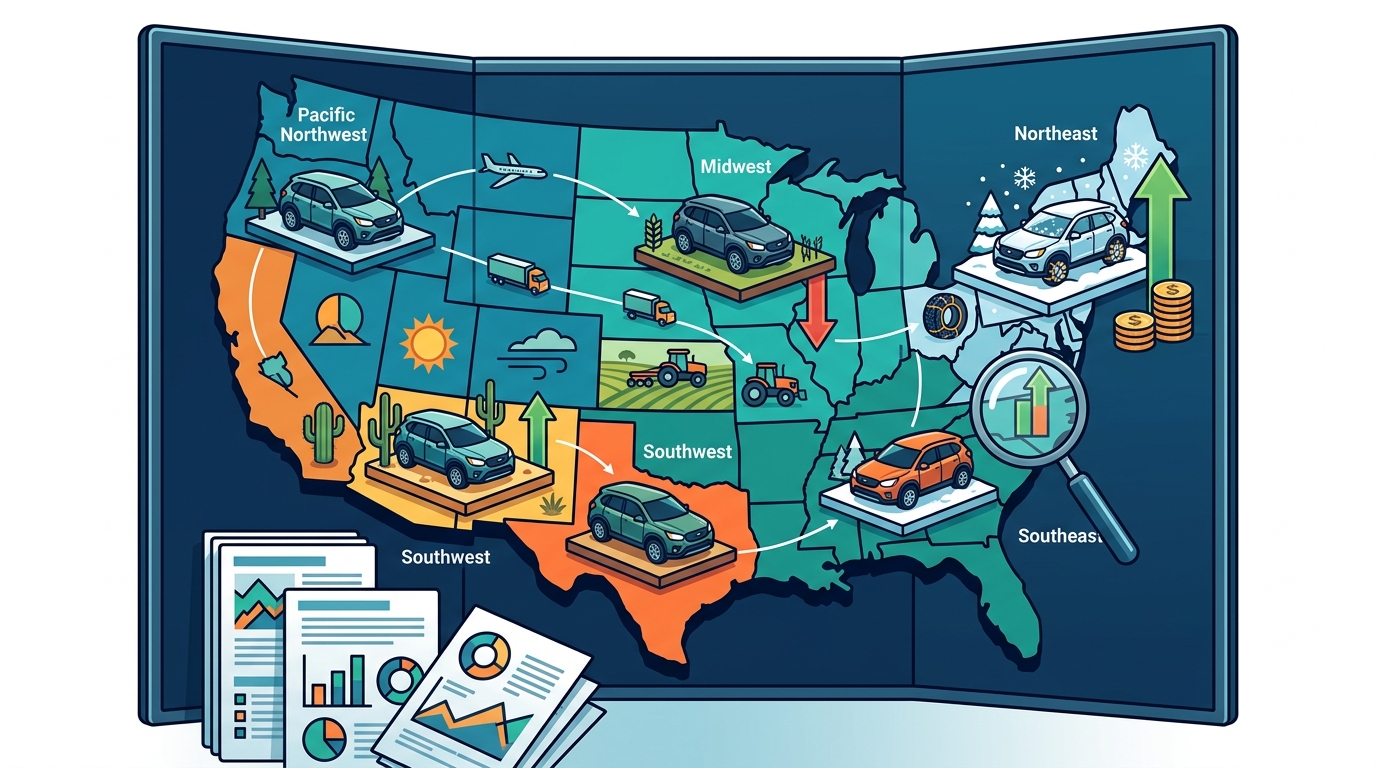
Weather does more than determine whether you need winter tires. Vehicles that have spent their lives in dry, warm climates such as the Southwest generally experience less rust and corrosion than those in the Northeast, where salted roads in winter cause significant undercarriage damage. Buyers in rust-prone areas may be willing to pay a premium for a vehicle from a milder climate. Conversely, extreme heat can degrade interior materials and paint in ways mileage alone does not reveal.
This climate effect creates cross-regional arbitrage: savvy buyers in the Rust Belt routinely source cars from southern and southwestern states, which pushes prices up in those origin markets and compresses margins in corrosion-heavy zones.
Vehicle-Type Preferences by Region
Not every vehicle enjoys the same demand everywhere. In areas with harsh winters, all-wheel-drive and four-wheel-drive vehicles are in higher demand because they offer better traction on snow and ice. Warm, coastal regions tend to favor convertibles and fuel-efficient cars. A four-wheel-drive truck might command premium pricing in rural mountain areas while sitting longer on lots in urban markets.
Regional industry presence also matters. Areas with mining, construction, or agriculture show higher demand for trucks and utility vehicles, pushing prices above national averages for those categories. Meanwhile, the Northeast often experiences higher car values due to greater demand for compact and fuel-efficient vehicles in densely populated urban centers, and the South is witnessing a rising preference for SUVs and trucks that reflects cultural buying habits.
Electric Vehicles: A Special Case
EV pricing is especially region-dependent. Electric vehicles are becoming more desirable in urban areas with developed charging infrastructure and incentives for eco-friendly transportation. However, in rural areas with fewer charging stations, traditional gas-powered vehicles still command higher resale prices. Used EV prices have generally been declining as automakers slash new-model prices to compensate for lost federal incentives, though the April 2026 CARFAX index showed used EV prices climbing more than $560 in a single month—proof that regional and seasonal micro-trends can override broader patterns.
Local Economics and Purchasing Power
Regional economic conditions—including local income levels, employment rates, and car demand—serve as primary drivers of used vehicle prices. In booming economies where people have more disposable income, demand for newer, high-end vehicles increases, letting sellers fetch better prices. During economic downturns, buyers gravitate toward affordable, fuel-efficient options, which depresses the resale value of larger or luxury vehicles.
Higher-income regions do not always correlate with higher prices. Competition and supply factors often play more significant roles. Population density and the availability of public transportation also affect demand: urban areas with excellent transit may show lower used-car values, while rural areas with limited alternatives support higher pricing.
Supply, Inventory Days, and Dealer Competition
Inventory levels vary significantly by state. For example, in spring 2026 Maine has a 114-day supply of new cars while Utah has just a 43-day supply. That disparity means a seller in a low-inventory market has far more leverage than one in an oversupplied region. Local competition among dealerships and private sellers further shapes conditions—competitive pricing strategies can stimulate sales but may also push resale values down.
At the national level, there are still roughly 580,000 leftover 2025 model-year vehicles sitting on dealer lots, creating localized pockets of opportunity for both buyers and sellers depending on brand mix.
Seasonality Amplifies Regional Effects
Seasonal demand patterns vary by vehicle type and region. Convertibles peak in spring, while four-wheel-drive vehicles command higher prices before winter. Used-car prices tend to be lowest during winter months when overall demand decreases, and spring is historically when used-car values appreciate—2026 is no exception, with auction data showing values appreciating two to three weeks earlier than normal.
Timing a sale to coincide with the peak-demand season for your specific vehicle type, in your specific region, can add hundreds or even thousands to the transaction price.
Transportation and Logistics Costs
Shipping costs create a pricing floor in geographically isolated markets. The logistics of transporting vehicles to Alaska create substantial additional costs that are passed on to consumers. Fuel costs vary by region too: shipping routes through states with higher diesel taxes—such as California or parts of the Northeast—carry higher per-mile expenses, whereas Midwest or Southern routes benefit from lower fuel prices. In 2026, the average cross-country shipment on an open trailer costs approximately $1,382, a figure that can erode or enhance the price advantage of sourcing a vehicle from another state.
Tariffs and Macro-Level Forces in 2026
Regional demand does not operate in a vacuum. In 2026, tariff directives of up to 25% on imported parts and completed vehicles have added thousands to new-vehicle sticker prices, with the average new-car transaction price now approaching $50,000. That sticker shock pushes more consumers into the used market, intensifying regional competition for pre-owned inventory. Used-car quality is also declining—the average mileage on a used car for sale now exceeds 70,000 miles, and there is only a 38-day supply of vehicles priced under $15,000.
The global used-car market itself is projected to grow from $1,263 billion in 2026 to over $2,080 billion by 2034 at a 6.43% CAGR, reflecting sustained demand across all regions.
How to Use Regional Demand to Your Advantage
- Research comparable sales in your metro area and neighboring states. Online marketplaces, dealership trade-in values, and auction results reveal what similar vehicles actually sell for in different markets.
- Identify your vehicle's regional sweet spot. If you own an AWD SUV, markets with snowy winters will value it more. A convertible? List it in spring in a Sun Belt state.
- Factor in total transaction costs. A higher sale price in another state means nothing if transport, registration fees, and taxes consume the margin.
- Time the sale strategically. Align your listing with the seasonal peak for your vehicle type in your region.
- Leverage AI-powered valuation tools. Modern pricing engines analyze historical transactions, vehicle condition data, and regional demand signals to establish more accurate valuations than static national guides.
Key Takeaways
- Median used-car prices in 2026 range from under $8,000 (Delaware) to nearly $33,000 (Alaska)—location is one of the largest single variables in vehicle pricing.
- Climate, local industry, fuel prices, and cultural preferences all shape which vehicle types command premiums in a given region.
- Inventory supply days, dealer competition, and seasonal cycles create timing-based opportunities that compound geographic effects.
- Tariff-driven new-car price increases are funneling more buyers into the used market, heightening the impact of regional demand on resale values.
- Cross-state shopping can unlock value, but transportation costs, taxes, and registration fees must be included in any comparison.
Frequently Asked Questions
Why is my car worth more in one state than another?
Price differences across states result from local supply and demand dynamics, shipping and transportation costs, state taxes and registration fees, and regional economic conditions. Geographic isolation, population density, and local competition levels also play significant roles.
Does weather really affect my car's resale value?
Yes. Cars from areas with harsh winters may show more wear and corrosion than those from moderate climates, and buyers factor that into what they are willing to pay. A rust-free vehicle from the Southwest can command a premium in northern states.
Are electric vehicles priced differently by region?
Absolutely. EVs are more desirable in urban areas with developed charging infrastructure. In rural areas with fewer charging stations, gas-powered vehicles still command higher resale prices. New EV prices are falling 3–8% in 2026 due to competition and lost federal incentives, but used EV prices can spike in specific regions with strong demand.
When is the best time to sell my car?
It depends on the vehicle type and where you live. Convertibles sell best in spring, four-wheel-drive trucks peak before winter, and overall used-car values tend to appreciate in spring. In 2026, auction data showed seasonal appreciation starting two to three weeks earlier than normal.
Should I sell my car in a different state to get a higher price?
It can be worthwhile, but you must calculate total costs including transport (roughly $1,382 for a cross-country open-trailer shipment), state-specific taxes, registration fees, and your own travel expenses. Only proceed if the net gain clearly justifies the effort.