

You have two realistic paths when it is time to part with your vehicle: hand the keys to a dealer as a trade-in, or list it yourself and sell directly to a private buyer. The dollar difference between these two routes is real—but it is smaller (or larger) than most people think, depending on a handful of variables unique to your situation. This comparison breaks down the hard numbers, hidden costs, tax implications, and time trade-offs so you can make the choice that actually puts the most money in your pocket.
The Raw Price Gap: How Much More Can You Get Selling Privately?
Industry data consistently shows that private-party sales bring in more money than dealer trade-ins. On a vehicle in the $10,000–$20,000 range, the gap between the private sale price and the trade-in offer typically runs $1,500 to $2,000 before any other factors are considered. In percentage terms, private party sales typically yield 15–25% more money than dealer trade-ins across most mainstream vehicles.
That gap can widen significantly for certain categories. Older vehicles with higher mileage show an even larger spread: cars with more than 100,000 miles have been found to average roughly double the private-party value compared to instant-offer platforms like Carvana. Meanwhile, newer vehicles under three years old with low mileage show a narrower gap—about 25% higher private-party value versus an online dealer offer, which can drop to roughly 15% after accounting for trade-in tax credits.
Rare, collectible, or heavily modified vehicles almost always bring significantly more through private sale or specialty auction than through a dealer trade-in, because dealers rarely have the niche buyer network to recoup top dollar on those units.
Why Dealers Always Offer Less (And Why It Is Not a Rip-Off)
Dealerships are not simply pocketing the difference between your trade-in and the retail sticker. The markup covers real operational costs. On a car acquired for $12,000, a dealer typically spends $1,200 to $2,500 on reconditioning, transport, photography, detailing, and overhead before a single dollar of profit is added. Net profit margins across the entire dealership typically land at just 1–2% of total sales.
The pricing hierarchy is straightforward: acquisition cost + reconditioning + overhead + profit = retail price. Your trade-in offer is the acquisition cost—always the smallest number in that equation. Understanding this removes the emotional frustration from the negotiation and lets you focus on the variables you can actually control.
The Trade-In Tax Advantage That Changes the Math
In the majority of U.S. states, when you trade in a vehicle while purchasing another, you only pay sales tax on the difference between the new car price and your trade-in value. This is one of the most overlooked financial benefits of trading in.
Here is a concrete example: you sell a car worth $10,000 and buy a $30,000 vehicle. Without the trade-in, you pay sales tax on the full $30,000—at a 7% rate, that is $2,100. With the trade-in applied, you pay tax only on the $20,000 difference—$1,400. That is a $700 tax savings that directly reduces the real-world advantage of selling privately.
If you live in a state with a sales tax rate of 6% or higher and you are buying an expensive replacement vehicle, the tax savings can offset a meaningful portion of the private-sale premium. However, seven states—California, Washington D.C., Hawaii, Kentucky, Michigan, Montana, and Virginia—do not offer this trade-in tax credit. Sellers in those states keep the full private-sale premium and have a stronger financial case for selling privately.
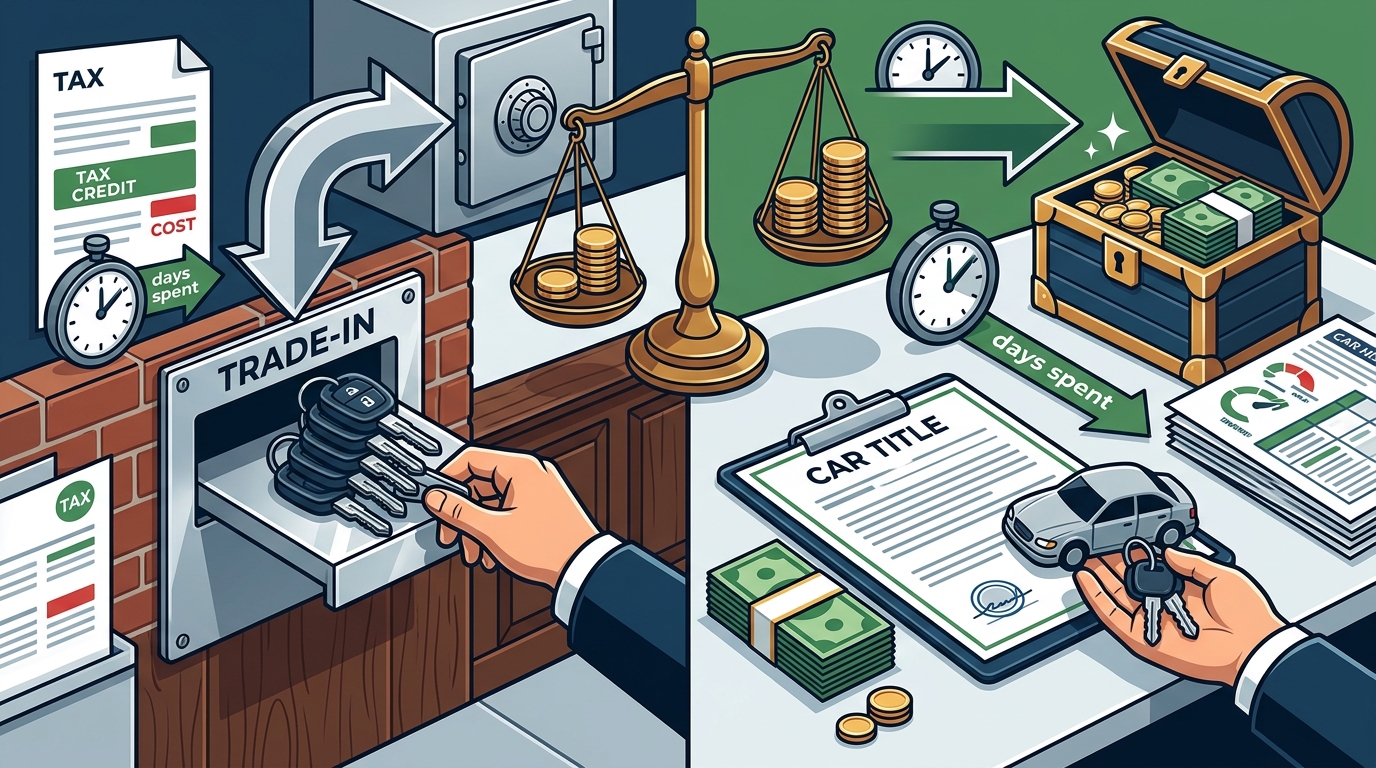
Putting a Dollar Value on Your Time
Creating listings, taking photos, answering calls, scheduling test drives, dealing with no-shows, and handling paperwork typically takes 8 to 16 hours spread across two to six weeks for a popular model. Less desirable cars or those in fair condition can sit on the market for 60 to 90 days.
For context, someone earning $60,000 per year is valuing 15 hours of effort at roughly $435. After subtracting that time cost and approximately $200 in detailing and prep, a $2,000 private-sale premium can shrink to roughly $1,300 in real gain—still worthwhile for many, but not the windfall it appears on paper.
A trade-in, by contrast, can be completed during a single dealership visit, often the same day you purchase your next vehicle. That time savings alone tips the scale for sellers who have demanding schedules or who simply value convenience over marginal dollars.
Real-World Scenario Walkthrough
Let us walk through a realistic 2026 example with a 2020 Honda CR-V, 55,000 miles, in good condition:
| Factor | Private Sale | Dealer Trade-In |
|---|---|---|
| Expected sale price | $22,500 | $19,500 |
| Prep costs (detail, listing, inspection) | −$450 | $0 |
| Time invested (est. 12 hrs × $30/hr) | −$360 | −$60 (1–2 hrs at dealer) |
| Trade-in tax credit (7% on $35K new car) | $0 | +$1,365 |
| Net financial outcome | $21,690 | $20,805 |
In this scenario the private sale still wins by about $885. But change the state to California (no trade-in tax credit) and the gap jumps to over $2,200. Change the seller's hourly value to $75 and the gap shrinks to under $500. The variables matter enormously.
When a Trade-In Is the Smarter Financial Move
- You are buying a replacement vehicle at the same time and your state offers the sales-tax credit. The real difference after taxes and time often shrinks to a few hundred dollars.
- Your car is approaching 100,000 miles or is about to lose its factory warranty. Values drop once a car crosses those marks, and getting ahead of the decline can improve the trade-in offer relative to the effort of selling privately.
- The vehicle has a lien. Dealerships handle lien payoffs daily. Private buyers generally expect a clean title on the spot, and many will not wait days for a bank to release a title—or they will negotiate the price down to compensate for the inconvenience.
- Your time is expensive. If your hourly earnings exceed what you would gain through a private sale, the convenience of trading in becomes financially justifiable.
- Cosmetic fixes would not move the needle. Dealers budget their own reconditioning costs regardless of what you have already done, so a $300 detail rarely adds $300 to their offer. If your car needs work you would rather not do, the trade-in penalty is smaller than you think.
When Selling Privately Pays Off
- You are not buying another car immediately. Without a simultaneous purchase the trade-in tax credit does not apply, so you keep the full premium.
- Your car is well-maintained and in demand. Popular models in good condition typically sell privately in two to four weeks.
- You own a rare, classic, or heavily modified vehicle. Niche buyers will pay significantly more than a dealer's wholesale estimate for specialized vehicles.
- You live in a state with no trade-in tax credit—California, D.C., Hawaii, Kentucky, Michigan, Montana, or Virginia.
- Your car has high mileage. Dealers will usually send older, high-mileage trade-ins to wholesale auction, which means added costs for them and a lower offer for you. Private buyers shopping in that price bracket tend to be more flexible.
2026 Market Conditions to Factor In
The used-car market in 2026 has stabilized compared to the pandemic-era highs, but several forces are shaping pricing:
- Industry forecasters expect average transaction prices to edge up roughly 2–3% in 2026 as tariffs and higher costs flow through the supply chain.
- Fuel-efficient vehicles, compact SUVs, and reliable sedans under $25,000 are particularly attractive to dealers looking to fill their used-car lots.
- SUVs and trucks continue to move fastest in spring and early summer, making seasonal timing relevant for private sellers.
- EVs and hybrids with verified battery health are retaining value better, especially when sold with active warranties.
- Cars with dealership service documentation have been shown to retain up to 10–15% more value at resale.
Sellers who can time their sale—listing in spring, documenting maintenance history, and selling before major mileage milestones—will extract more value regardless of which route they choose.
Your Decision Framework: Five Questions to Ask Yourself
- Am I buying another car at the same time? If yes, calculate the tax credit in your state before comparing prices.
- How quickly do I need the money? Urgency favours the trade-in; patience favours the private sale.
- Is there a lien on my title? A lien makes private sales significantly more complicated.
- What is my car's category? Mainstream sedans have a smaller private-sale premium than trucks, SUVs, or specialty vehicles.
- What is my time actually worth? Be honest. Multiply your effective hourly rate by 12–15 hours and subtract it from the expected private-sale premium.
Key Takeaways
- Private sales typically return 15–25% more than trade-ins, but the net advantage after tax credits, prep costs, and time can shrink to a few hundred dollars.
- The trade-in sales-tax credit is the single biggest variable—it can save you $500–$1,500+ depending on your state and the price of your replacement vehicle.
- Sellers in states without the trade-in tax credit (CA, DC, HI, KY, MI, MT, VA) have the strongest case for selling privately.
- High-mileage, rare, and specialty vehicles almost always net more through private sale.
- Get at least three valuations (KBB, Edmunds, and one dealer appraisal) before committing to either path.
- Timing matters: spring and early summer are the strongest selling seasons, and selling before the 100K-mile mark preserves value.
Frequently Asked Questions
How much more money will I get selling my car privately versus trading it in?
On most mainstream vehicles, private sales yield 15–25% more than a dealer trade-in. In dollar terms, that translates to roughly $1,500–$2,000 more on a car valued between $10,000 and $20,000. However, after accounting for prep costs, your time, and potential trade-in tax savings, the net difference can be significantly smaller.
Do I have to pay sales tax differently if I trade in my car?
In most U.S. states, trading in your vehicle when purchasing another means you only pay sales tax on the difference between the new car's price and your trade-in value. Seven states—California, Washington D.C., Hawaii, Kentucky, Michigan, Montana, and Virginia—do not offer this credit.
How long does it take to sell a car privately?
Popular models in good condition typically sell in two to four weeks. Less desirable vehicles or those in fair condition can take 60 to 90 days. You should budget 8 to 16 hours of active effort for photos, listings, inquiries, test drives, and paperwork.
Is it harder to sell privately if I still owe money on my car?
Yes. Private buyers generally expect a clean title at closing. If your lender holds the title, the process requires coordinating payoff with the bank, which can take days and may discourage some buyers. Dealerships handle lien payoffs routinely and can settle the balance directly with your lender.
What types of cars are better to sell privately versus trade in?
Rare, collectible, or heavily modified vehicles almost always perform better in private sales or specialty auctions. High-mileage cars also tend to fare poorly at dealer trade-in because many dealers send them straight to wholesale auction. Mainstream, newer vehicles in good condition still benefit from private sale, but the margin over a trade-in is narrower—especially when tax credits apply.
What is the best time of year to sell a used car?
Spring and early summer see the highest demand, particularly for SUVs and trucks. Selling before a new model-year launch can also help you avoid depreciation from the incoming inventory pushing older models down in price.